·Paper Review·3 min read
ASTRA: A Negotiation Agent with Adaptive and Strategic Reasoning via Tool-integrated Action for Dynamic Offer Optimization
A negotiation agent that makes offers using partner modeling and numerical optimization
Deuksin Kwon et al.·EMNLP 2025·Paper ↗
Problem
Negotiation agents based on reinforcement learning are locked into fixed reward structures, so they can't adapt well when the other side changes its behavior mid-conversation. There has been a lot of recent work on LLM-based negotiation agents, but most of it sticks to simple single-issue negotiations. Put those agents into complex multi-issue negotiations and they tend to make irrational or losing offers.
ASTRA doesn't stop at generating text. On every turn, it uses a math tool called an LP solver like a dynamic reward function to optimize its offers.
Method
Here is how ASTRA builds an offer.
- It reads the partner's message and judges their fairness and stance.
- It uses an LP solver to pick a set of strong offer candidates.
- It uses a simulated partner agent to estimate how likely each candidate is to be accepted (PAP).
- It checks whether each candidate fits a good strategy for the current situation (SA).
- It adds up PAP and SA to choose the final offer.
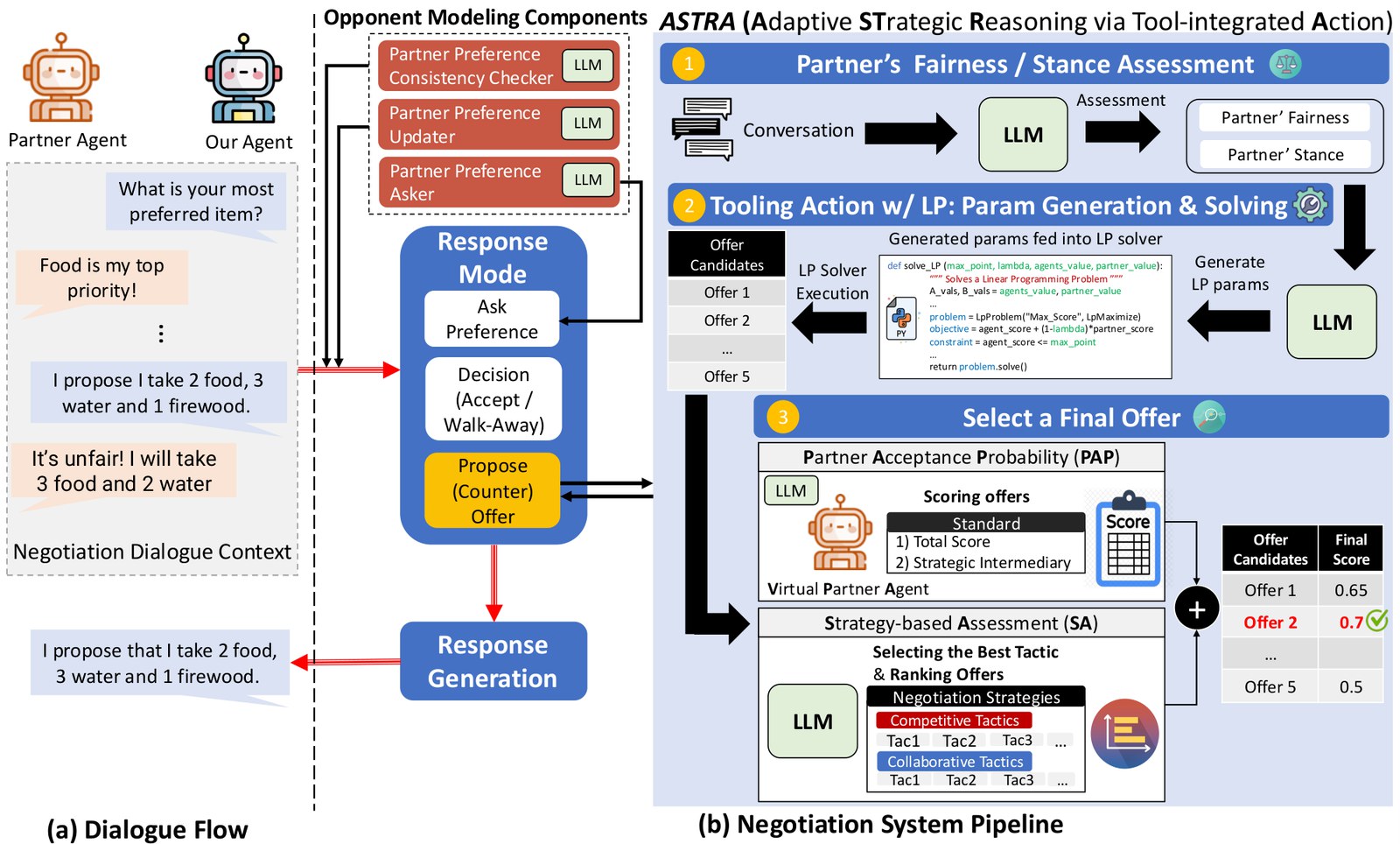
What makes it different is that it isn't just an agent that talks well. It's an agent with a calculator. It works out favorable terms close to Pareto optimal, meaning a point where neither side can gain more without the other side losing something.
Results
With ASTRA, the agent averaged 24.34 points when a deal was reached. That's about 3.6 points higher than the same agent without ASTRA, which scored 20.75. The experiment splits three kinds of items with high, medium, and low priority, so the gap is roughly one more medium-priority item.
When negotiation experts rated how effective the strategies were, ASTRA also scored 0.93 points higher on average than the agent it was compared against. It also came up with new, favorable offers the experts hadn't thought of about 28% of the time.
My Take
When people imagine an agent negotiating, they usually picture a mechanical exchange of numbers, like offering 3 chairs and 1 air freshener. So it was interesting that this one negotiates in casual conversation, based on real human dialogue data, and still gets meaningful results.
The authors say ASTRA has more potential as a negotiation coach or decision support tool than as a replacement for people. I also think AI should grow toward strengthening what people can do rather than replacing them, so I liked that direction.
What Could Be Better
In the expert evaluation, experts were asked which offer was newer and better, theirs or ASTRA's. But the question was phrased in a leading way, asking how much better ASTRA's offer was than theirs. The answer options also lumped every case where the expert's own offer was better into a single Same or Worse choice, so the results may be somewhat biased. I'd be curious to see what a fairer evaluation would show.
Also, in real negotiations, emotional satisfaction matters as much as numerical gains. I'm not sure how far ASTRA's numerical optimization can go in meeting that.